
Lost in Space
Unlearning and resistance while leaving the Jehovah's Witnesses

We learn words and their definitions by osmosis when we are little ones. But what happens when you learn wrong? More importantly, what’s it like to fundamentally change your concept of a word?
For much of my life, I felt that love was conditional. It depended on my behavior, thoughts, and beliefs aligning with the religious organization I grew up in, The Watchtower Bible and Tract Society (also known as Jehovah’s Witnesses).
Unconditional love was something only the “world” spoke about, especially in TV and movies. Phrases like, “family first” were regarded with suspicion in our house. “Family first” was a lie of Satan’s world; Jehovah (God) always came first.
One of my earliest memories is of sitting in my car seat and watching my mom pump gas. I saw my grandmother pull up across the gas station island to fill up her tank. I wanted to call out, “Hi Meme!” But I didn’t.
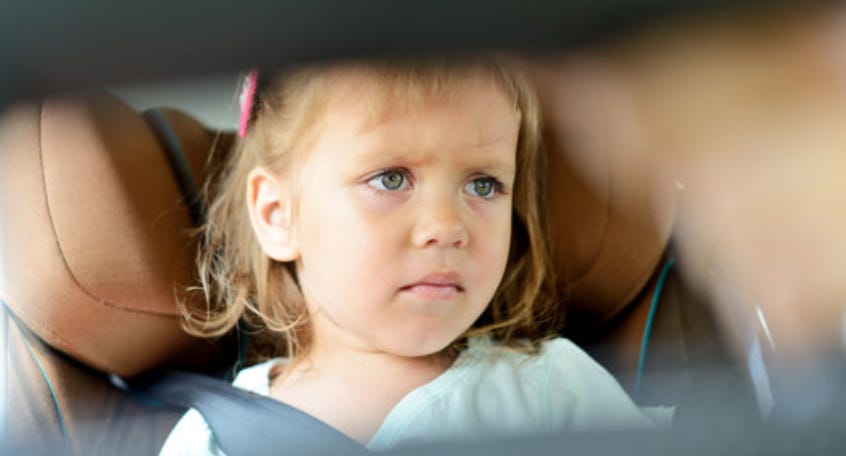
Meme had been “disfellowshipped.” This was when a person was shunned for breaking the rules of our faith. They couldn’t return unless a judicial committee of elders decided they were repentant enough to rejoin the community.
Even as a small child in my car-seat, I knew to keep quiet. My grandmother said “hello” to my mom. My mom turned her back and finished pumping the gas in silence. I kept silent on the way home. My mother was very emotional and rather volatile and even as a small child I would try very hard not to provoke her in any way. Seeing my mother coldly refuse to acknowledge my grandmother sent a shiver down my backside.
I only recently started to process the implications of this memory as I move through a process of deconstructing my faith. The thought of making one mistake, maybe even by accident, and being completely removed from everyone and everything I loved was dizzying. Like I was floating adrift in space with no orientation or sense of balance.
Before my deconstruction, I could remind myself that problems like this were the fault of Satan who was always trying to pull us away from our Father. God was not to blame for this separation; it was Satan who took Meme from us. Or, rather, Meme CHOSE to leave us for “Satan’s world.”
Obviously, all of this was too much for a little girl’s mind and body to process so my nervous system snapped into protective mode and I reconciled my sad and scared feelings by telling myself I would be perfect and not make a mistake. Meme must be bad. I would pray that God would save her and bring her back to us.
People pleasing and perfectionism would be my preferred methods to cope with this and other mental distress for a long time.
As a Jehovah’s Witness, I believed that my faithful relatives and I would one day be resurrected into Paradise. I believe this made me unfeeling when they passed away. I remember a twinge of guilt that I cried more when my cat died than when my grandfather passed away. I would see him again in Paradise, but Midnight, my precious tuxedo cat hit by a car that Thursday night? She was dead forever.
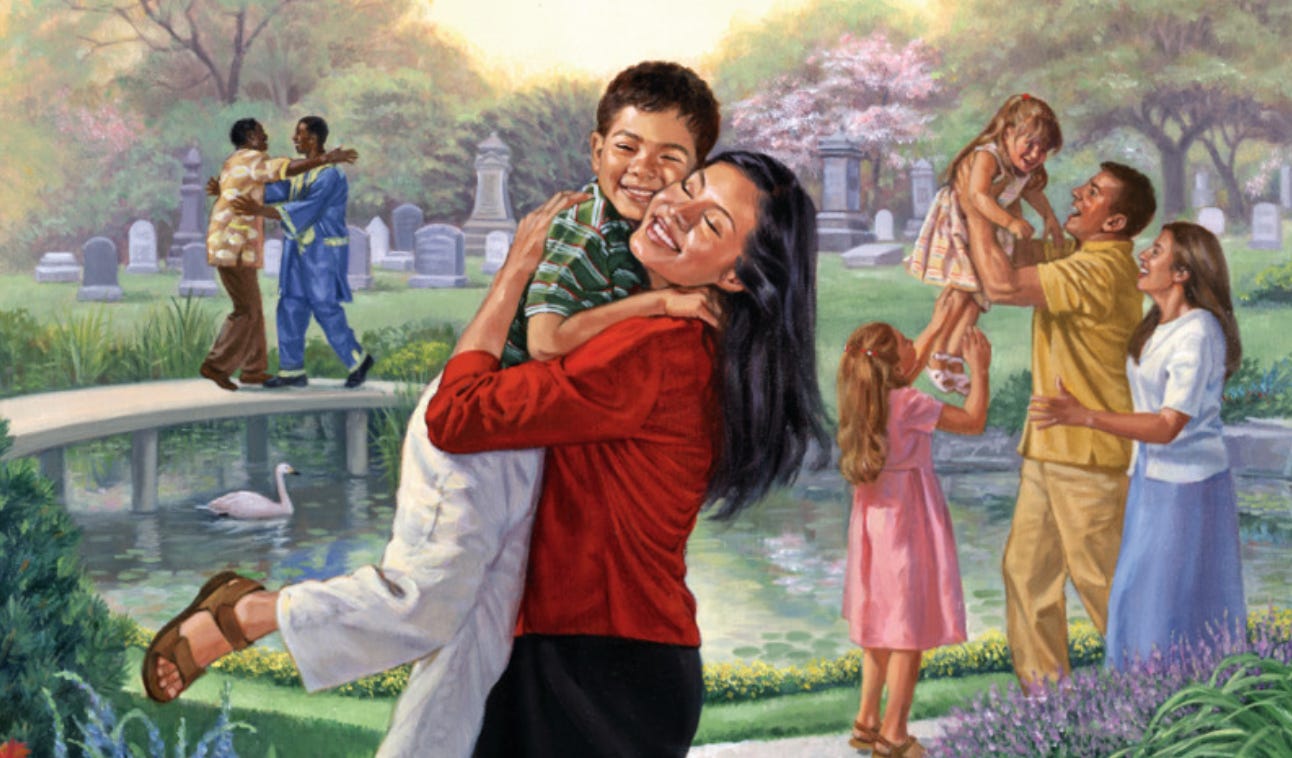
It feels shameful to admit now, but we believed that those who were not Jehovah's Witnesses would be killed at Armageddon. At the same time, we also believed that they too would be resurrected into Paradise and have a final opportunity to accept or reject Jehovah.
So, when my unbelieving relatives died, I felt relieved and happy because I thought they would now have a real chance at living forever. After all, once resurrected to paradise and realizing we were right about God, how could they not love and want to join us on a beautiful, clean, and happy Earth, surrounded by everyone and everything they loved?
Waking up to this bizarre belief system started in earnest for me during the beginning of the COVID-19 lockdowns, Spring, 2020. The time away from the constant hamster wheel of church activity gave me a chance to deeply think and research some of the questions I hadn’t settled in my heart and mind. Once it started, the process was quick. Secretly, I dismantled the fundamental cornerstones of my faith, one by one. Getting out physically took much longer. I stopped attending the midweek meetings in June 2023. March 2024 was the last month I attended a Sunday meeting or participated in the field ministry.
Years later, as an adult who was investigating the history of my faith and my own memories, I asked my mom why she didn’t even say hello to Meme, her own mother that sunny afternoon.
My mom remembered the exact interaction. She told me if she had said one word to Meme she “Wouldn’t be able to stop at that.” The floodgates would be opened and she would have ended up talking to her mom all the time.
I’ve read Watchtower articles about disfellowshipping published in the mid-1970s to 1980s. These articles advised readers not to greet those who were disfellowshipped, suggesting that even a single word could lead to further conversation, which would demonstrate a lack of respect for Jehovah’s way of handling matters.
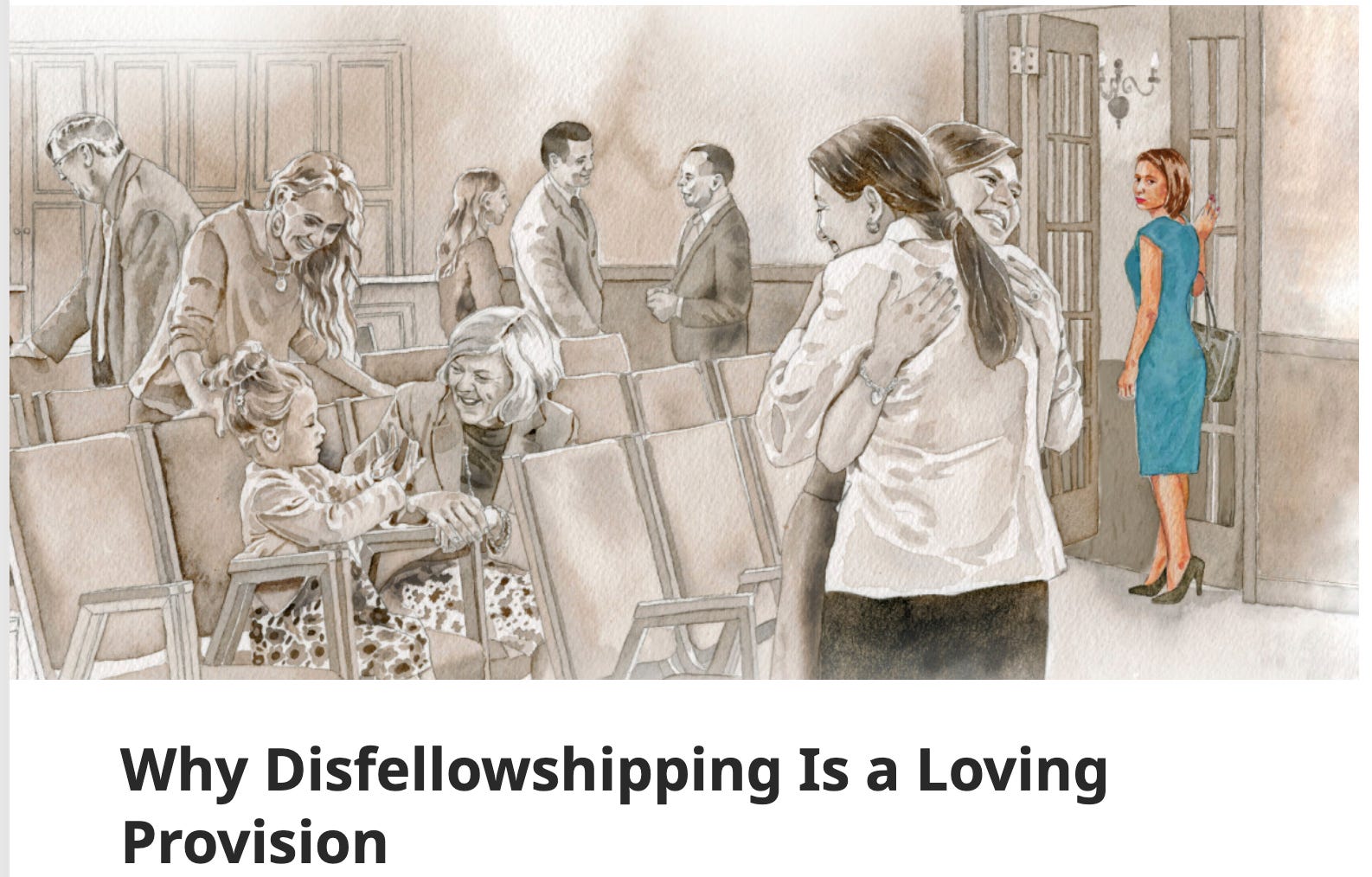
Hearing my mom parrot back the words of these articles almost word for word pained me deep in my heart.
A few years ago I was compelled to ask her, “ Did YOU really feel that way? That you shouldn’t even say hello?” She answered, “I didn’t want to take the chance.”
I realized how much of her response was based on fear. Fear that she didn’t have self-control. Fear she would risk Jehovah’s anger and possibly everlasting life on Earth if she said hello to her own mother.
At the time, my mind was just beginning to detach from the belief system I had inherited. My heart sank as I realized that if I ever left the faith, my mom would turn her back on me just as she had on her own mother. My brain whispered a confirmation: “Well, mom only had one mother, but she has five daughters.” Growing up in a large family, I often felt easily replaced, as interchangeable as a Lego block. Having shunned her mother, who later returned to the faith, my mom would strongly support the shunning arrangement, believing it had “worked” in bringing her mom back.
But I am not my mother. And I want to make different decisions.
A very early moment in my deconstruction came when my oldest child was about five or six. We were driving home from the Sunday meeting where the Watchtower Study had been on the topic of marriage. The conversation flowed to the subject of how, “We only get married to someone who worships Jehovah.” My son asked, ”But what if I don't worship Jehovah? What if I do something bad?” My husband replied,”If you leave Jehovah we won’t be able to talk to you until you are sorry and you come back to him.”
Those words hit me square in the chest. I could hardly breathe. Every fiber in my body cried out,” No! I’ll never do that!” But I kept a straight face and said nothing in the car.
When we got home, I spoke privately with my son. I told him that I know he is a good little boy and that everyone makes mistakes. I asked him not to tell anyone, but reassured him that no matter what, I would always love him and always talk to him.
Expressing this to him marked a significant turning point for me. I realized that I did not want to live eternally without my children. I knew the God I loved was not the Jehovah described in the Watchtower. This was the first time my inner thoughts directly conflicted with my physical reality.

When the subject of possibly losing one's family or children came up, some older members would explain that Jehovah would “wipe every tear from their eyes” (Rev 21:4), meaning that in the New World, Jehovah would erase the memory of those we lost so we wouldn't feel sadness or mourn. To me, this explanation was even worse. How can we learn or grow without memories? I didn't want to live in ignorant happiness.
I couldn't believe that the God I loved would do these things, so I told myself these members were just expressing their personal opinions on the issue. Looking back, any issues that troubled or concerned me in my faith, I would ignore or “put on my shelf,” borrowing a phrase from my Mormon cousins in faith. I would reassure myself that these were merely people's opinions and not the official doctrine of the church. If it were official doctrine, I believed it would be corrected with “new light” (Prov 4:18), a concept we used to justify changes in belief. Reading older publications was discouraged as these were considered “old light” or obsolete teachings. Later on, I learned that my mind was employing a logical fallacy known as the ”'No True Scotsman” fallacy to reconcile the internal conflict.
Unconditional love is a connection. Love can bring you back into the warmth and hold you close and protected after being in the cold void of space.
 | A guest post by
|
Fascinating! Have you read, "The Last Days" by Ali Millar? Your story reminds me of hers
No I haven’t read it. I’ll definitely read it. Thank you for the recommendation!